
High-Tonnage Aluminum Casting Manufacturer

Executive Summary
- Consolidate Responsibility: Using a single supplier for high-tonnage parts eliminates the logistical costs and quality disputes common in multi-vendor supply chains.
- Ensure Process Stability: Advanced automation, including robotics and press-side imaging, drastically reduces human error. This helps to ensure consistent part geometry.
- Protect Tooling Assets: Integrated maintenance programs extend the lifespan of expensive high-tonnage molds and prevent surface degradation.
Why Consolidate High-Tonnage Production?
Sourcing high-tonnage aluminum castings presents unique logistical and quality hurdles for procurement managers. Engineers often struggle to maintain dimensional consistency when moving heavy parts between multiple vendors for casting, machining, and finishing.
PHB Corp is a single-source high-tonnage aluminum casting manufacturer that integrates design, casting, and tooling to ensure production stability. Read on to learn more about optimizing your supply chain for large-scale aluminum casting.
Get a Quote for High-Tonnage Aluminum Casting
High-Tonnage Aluminum Casting Logistics Challenges
Splitting production steps across different vendors increases lead times and creates accountability gaps for quality defects.
The Impact of Supply Chain Gaps
Shipping heavy aluminum housings between multiple vendors increases freight costs and exposes parts to potential transit damage. Fragmented supply chains frequently suffer from quality disputes, as vendors may blame one another for porosity or dimensional issues discovered after machining. Consolidating these processes under one roof helps establish clear accountability from the initial metal injection through to the final quality inspection.
The Value of Centralized Accountability
Centralized manufacturing reduces administrative overhead and ensures a single point of accountability for the final product.
Why Choose PHB Corp as Your High-Tonnage Aluminum Casting Manufacturer?
PHB Corp utilizes advanced automation and integrated support services to deliver high-tonnage aluminum casting with superior consistency. Our ITAR-registered facility extends beyond basic casting to include comprehensive CNC machining, leak testing, and surface finishing. This helps ensure complex assemblies are completed under strict quality controls.
Our Integrated Manufacturing Capabilities
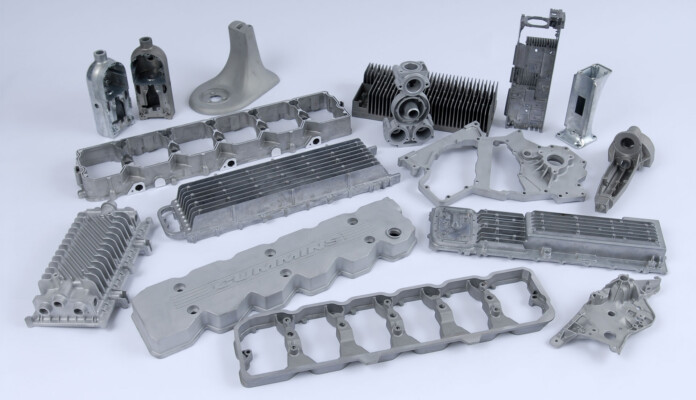
We have an array of high-tonnage aluminum presses that provide the necessary capacity and versatility to meet production demands for large-scale components without sacrificing precision. Achieving this level of accuracy requires a suite of advanced technologies:
- Process Monitoring: Real-time sensors track injection parameters to detect deviations immediately.
- Robotics: Automated ladling and extraction systems maintain strict thermal stability.
- MAGMAsoft® Process Simulation: Digital modeling predicts metal flow to optimize mold design.
- Preventative Tool Maintenance: Continuous maintenance programs prevent wear and tear.
Ensuring Reliable Production Outcomes
PHB is a premier aluminum casting manufacturer that uses advanced integrated technologies to reduce cycle times and costs and deliver high-quality components. This process ensures every component meets rigorous industry standards.
Optimizing Large Part Design Through Process Simulation
MAGMAsoft® Process simulation predicts thermal stresses, solidification defects, and air entrapment before the physical mold is manufactured.
Predicting Potential Defects With Digital Twins
High-tonnage parts often feature complex geometries with varying wall thicknesses. These variations can lead to porosity or cold shuts if the metal does not flow correctly. Engineers use MAGMAsoft® Process simulation to create a digital twin (a virtual replica of the casting process) to test gate locations and predict defects before physical production begins.
This technology allows our engineering team to test different gate locations and overflow designs virtually. They can identify exactly where air pockets might form and adjust the design to eliminate them. Verification occurs before any steel is cut and eliminates the need for expensive, time-consuming modifications to the physical tool later in the process.
Preventing Costly Tooling Rework
Digital verification ensures the mold produces viable parts on the first run while saving significant development time and capital.
What Is the Value of In-House Tooling Maintenance?
Manufacturers who perform routine maintenance extend the life of the die and prevent surface degradation.
Integrated Die Repair and Maintenance
High-tonnage molds represent a significant capital investment. The extreme pressure and heat of the casting process naturally degrade steel over time. Even with regular preventative care, maintenance practices, temperature checks, coatings, and planning, molds develop “heat checking” (surface cracks), which compromises the part’s surface finish.
We leverage our subsidiary, Reddog Industries, to perform on-going tooling maintenance. This service is not included in our standard high-tonnage aluminum die casting services and does come at an additional cost. This supplement service involves regular cleaning, stress-relieving, and minor repairs conducted in parallel with production schedules. Because the tool shop is integrated with the casting floor, repairs can be made quickly without shipping the die to an external vendor.
Protecting the Capital Investment
Proactive maintenance maximizes the return on investment for the mold and ensures consistent part tolerances throughout the program.
High-Tonnage Aluminum Casting FAQs
Q: What tonnage range is considered “high-tonnage”?
A: Machines with clamping forces of 1,000 tons and above are typically classified as high-tonnage. This clamping power is essential to maintain dimensional stability during the injection of metal into molds with large projected surface areas.
Q: Can high-tonnage casting replace welded assemblies?
A: In many structural applications, a single large casting can replace multiple welded steel components, reducing weight and assembly labor. Consolidating parts into a monolithic design also eliminates potential leak paths and structural weak points associated with weld seams.
Q: What alloys are best for large aluminum castings?
A: Alloys such as 380 and 383 are commonly used for large parts due to their excellent fluidity and corrosion resistance. For smaller, highly detailed components, zinc die-casting offers tighter tolerances and thinner walls.
Q: How is porosity minimized in large-scale casting?
A: Vacuum assist systems and strategic overflow placement are used to evacuate air from the mold cavity immediately before injection. This ensures high density in critical structural areas where trapped gas would otherwise compromise strength.
Q: What is the typical lead time for high-tonnage tooling?
A: Building a large-format die typically requires14-18 weeks or sometimes even longer due to the complexity of the machining and heat-treating processes. Early involvement in the design phase can help streamline this timeline by identifying long-lead material requirements.
Partner With a High-Tonnage Aluminum Casting Manufacturer
Sourcing high-tonnage aluminum casting requires a strategic partner capable of managing the entire production lifecycle. Consolidating these processes under one roof helps establish clear accountability from the first shot through to the final quality inspection.
At PHB Corp, we combine extensive press capacity with in-house tooling support to deliver reliable, high-tonnage cast components. Our integrated manufacturing process secures the stability and precision needed for your most critical projects.
Click below for a quote and to learn more about optimizing your supply chain with our single-source solutions.
[/wpv-noautop]